The Pastor's Corner
January 2026
The Gospels tell of the life and teachings of Jesus. They show Jesus as a man of compassion for the marginalized members of society. He healed the sick, encouraged forgiveness, and commanded his followers to love one another.
Then Jesus went about all the cities and villages, teaching in their synagogues, and proclaiming the good news of the kingdom, and curing every disease and every sickness. When he saw the crowds, he had compassion for them, because they were harassed and helpless, like sheep without a shepherd. (Matthew 9:35-36)
“But I say to you, love your enemies and pray for those who persecute you,” (Matthew 5:44)
Warner Sallman’s painting The Head of Christ (1940) has always been a favorite of mine. For most of my childhood my grandparent’s Bible was situated on their coffee table and opened to this picture. They gave me a wallet-size, laminated version of it with Psalm 23 printed on the back; I still have it.
Sallman depicts Jesus as a young man with soft, flowing hair, a beard, and a handsome face. His use of light and muted colors, as well as the gaze of the subject, gives an impression of calm and peacefulness. Sallman’s painting, while not racially accurate, depicts a man who seems to have a similar character as the Biblical Jesus. My interpretation of this painting, rooted in my childhood, is more about the characterization of the subject than about the race of the subject. Surely Jesus’ appearance was similar to the men of his historical time period. Surely, he had long hair and a beard, like the other Jewish men in the first century. Jesus could have simply blended into the background.
“He had no form or majesty that we should look at him, nothing in his appearance that we should desire him.” (Isaiah 53:2)
It was not his appearance which attracted people to him. Jesus’s behavior and teachings were what drew people to him. “So, his fame spread throughout all Syria, and they brought to him all the sick, those who were afflicted with various diseases and pains, demoniacs, epileptics, and paralytics, and he cured them. And great crowds followed him from Galilee, the Decapolis, Jerusalem, Judea, and from beyond the Jordan.” (Matthew 4:24-25)
As we begin 2026, may we be a reflection of our Lord, Jesus. May we live so that others will know Jesus and know that they are loved by God.
In your relationships with one another, have the same mindset as Christ Jesus: Who, being in very nature God, did not consider equality with God something to be used to his own advantage; rather, he made himself nothing by taking the very nature of a servant, being made in human likeness. And being found in appearance as a man, he humbled himself by becoming obedient to death—even death on a cross! (Philippians 2:5-8)
Peace and blessings,
Rev. Teresa Reed
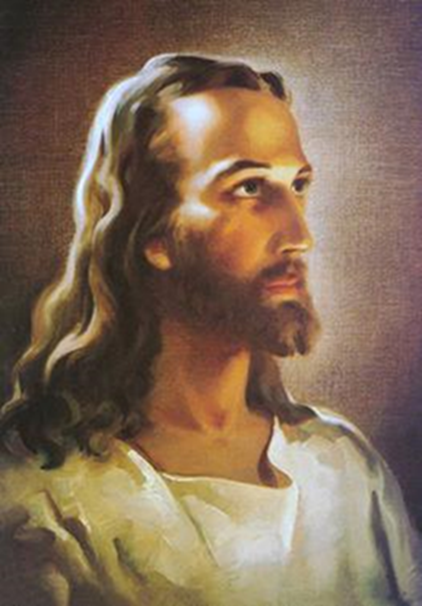
Warner Sallman, The Head of Christ, 1940, oil on canvas, Warner Press (via Kriebel & Bates, 1941 copyright).